
01. Introduction: With the Technology Mature, Decision Is the Bottleneck
The reliability of active acoustic systems (AAS) is no longer in question. Both regenerative and convolution-based approaches have more than a decade of proven deployments; latency, stability and sound quality have all crossed the usable threshold.
What actually traps owners and design institutes is another question: should this venue adopt active acoustics at all? Adopted wrongly, millions buy a showpiece whose modes are rarely switched; skipped wrongly, the venue is fixed at completion with no later remedy. The cost of a wrong selection decision far exceeds the risk of the technology itself.
This article offers a workable decision framework: sieve once with the physical limits of passive acoustics, once with the adoption signals of active acoustics, and once with the veto conditions. After three sieves, the answer surfaces by itself.
02. Sieve One: The Physical Limits of Passive Acoustics
Every selection starts with passive acoustics — it is both the foundation and the ceiling. Under GB/T 50356 (Code for Architectural Acoustic Design of Theatres, Cinemas and Multi-purpose Halls), the reverberation-time requirements of different uses are almost mutually incompatible:
| Use | Mid-frequency RT window | Core requirement |
|---|---|---|
| Conference / lecture | 0.8–1.1 s | Speech intelligibility first |
| Drama / theatre | 1.0–1.3 s | Clarity with some fullness |
| Variety / multi-use | 1.2–1.5 s | Compromise |
| Symphonic / choral | 1.6–2.2 s | Fullness and envelopment first |
Rule of thumb: if every use case falls within two adjacent RT windows, one passive design covers them all — no active acoustics needed. An 800-seat hall used mainly for meetings with occasional films and lectures is fully served by an RT around 1.0 s; adding active acoustics there means buying an expensive solution to a nonexistent problem.
Conversely, when the owner demands summits in the morning and symphonies at night in the same room, and the RT windows are more than 0.5 s apart, passive acoustics enters a physical dead zone — any fixed fit-out can only satisfy one end.
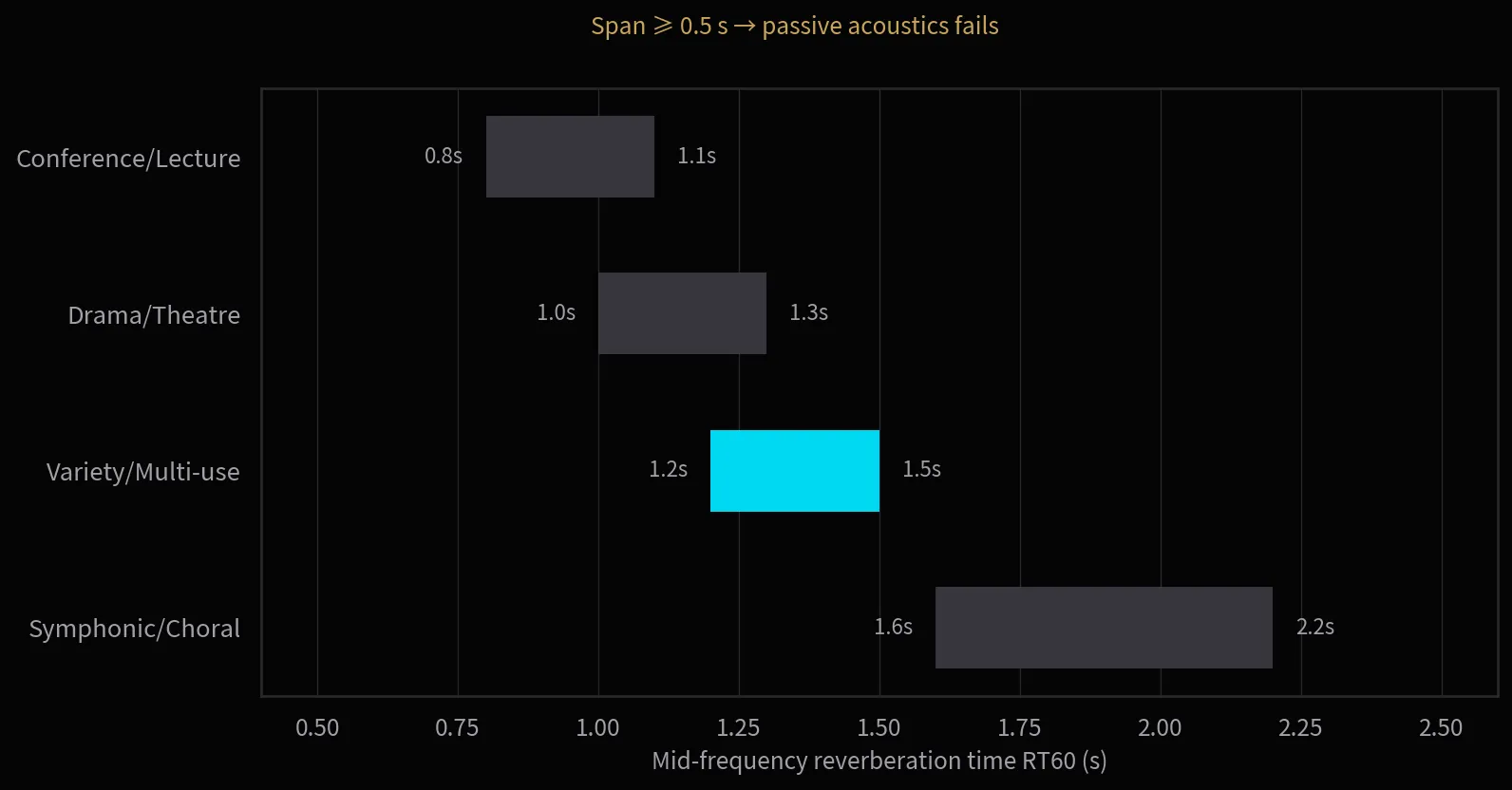
Figure 1
RT windows by use case: a span beyond 0.5 s marks the failure zone of passive acoustics.
03. Sieve Two: Adoption Signals for Active Acoustics
Active acoustics enters the candidate list only when at least two of the following signals are present.
Signal one: RT demand span ≥ 0.5 s. This is the hard indicator. A multi-use brief with a smaller span can be served by lightweight variable means such as deployable curtains.
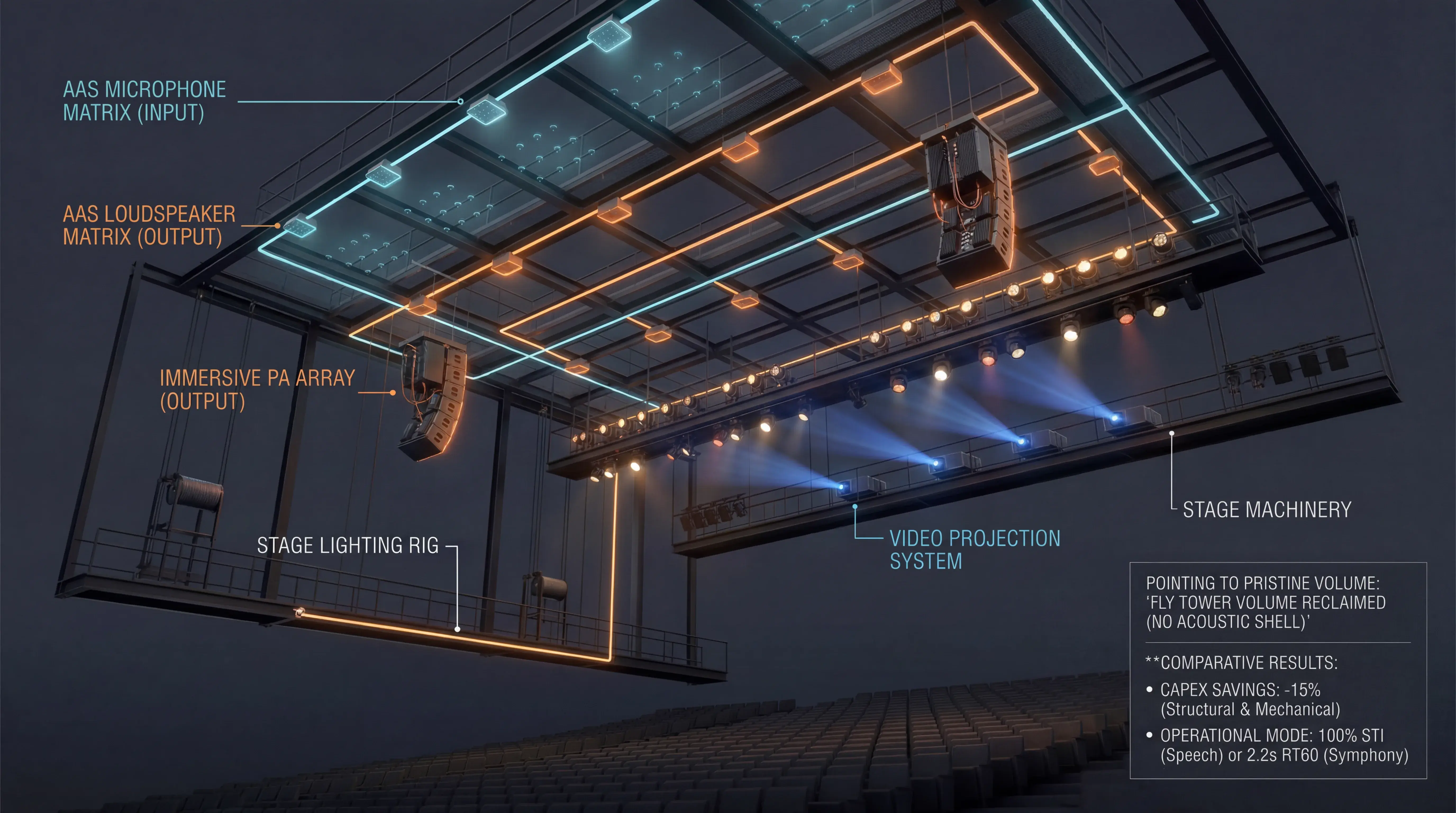
Signal two: mechanically variable acoustics is infeasible. The traditional answers — motorized orchestral shells, lifting absorptive banners — consume fly-tower volume, collide with lighting bridges and rigging, and depend on manual operation. If ceiling height is limited or stage machinery is already at capacity, the mechanical route should be ruled out at the drawing stage.
Signal three: the operator accepts button-press switching. The value of active acoustics scales with switching frequency. A venue that changes modes once or twice a year should not pay the electronic premium; a venue with different programs every day extracts maximum value at near-zero switching cost.
Signal four: the base room acoustics is sound. AAS can synthesize reflections and reverberation, but it cannot cure standing waves, flutter echoes or excessive background noise. Fix the foundation first, then talk about enhancement.
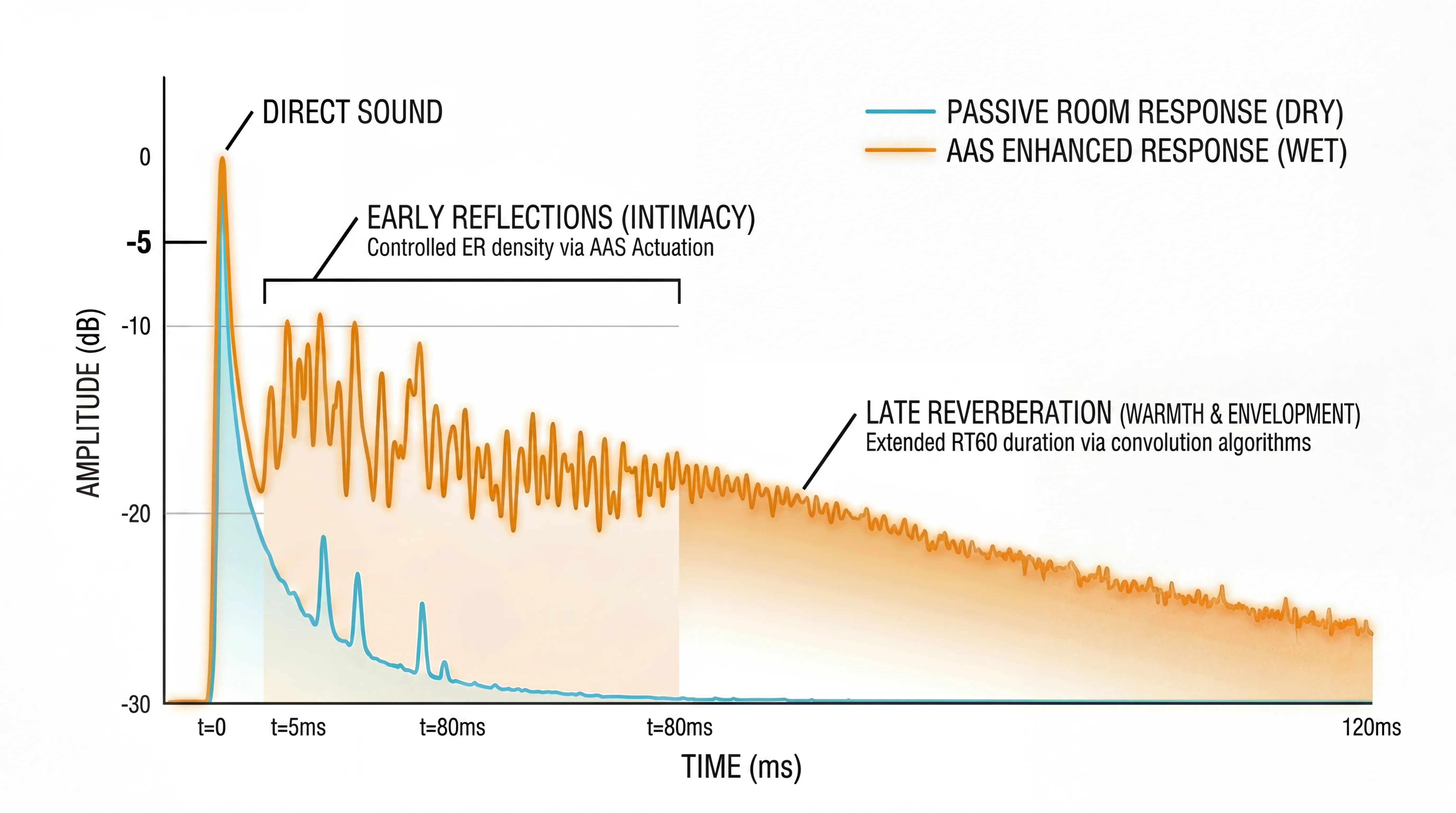
Figure 2
Impulse-response comparison: active acoustics synthesizes the reflection and reverberation energy the room lacks.
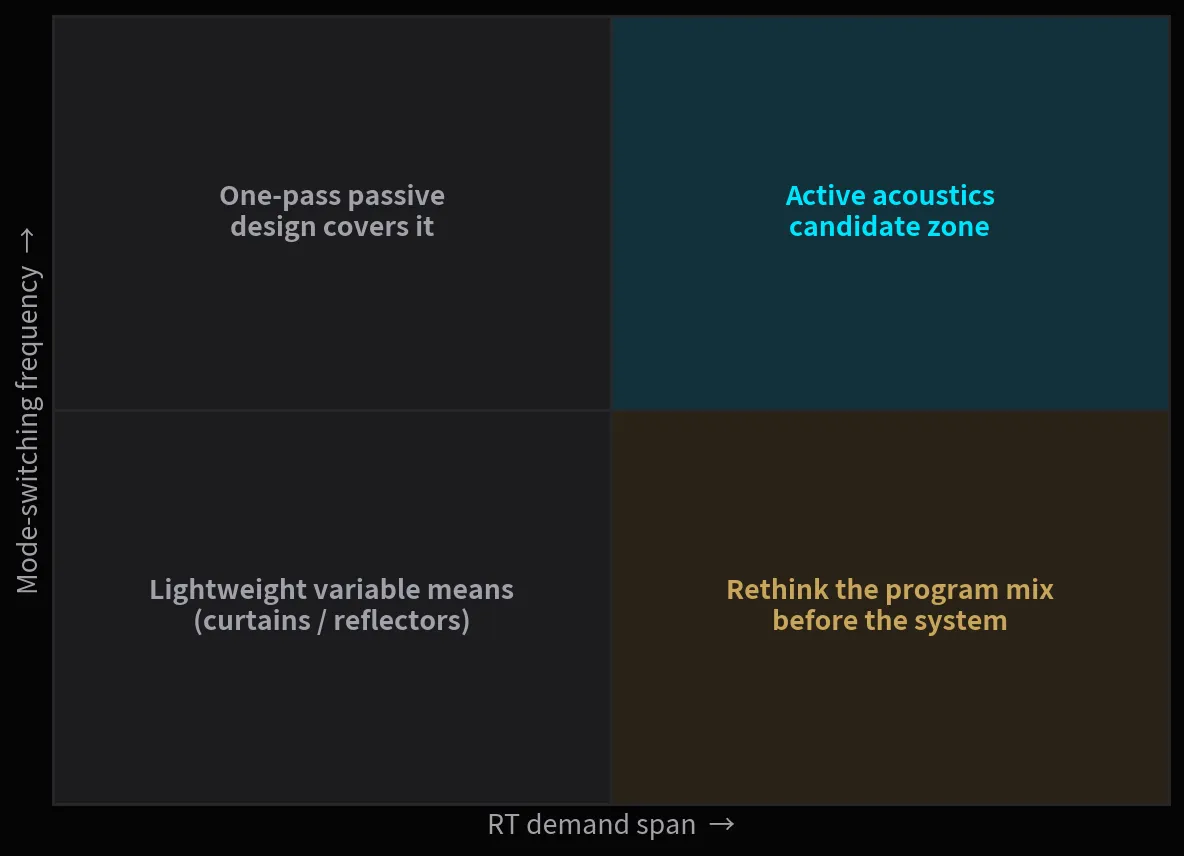
Figure 3
Selection quadrant: RT demand span × mode-switching frequency.
04. Sieve Three: Veto Conditions
Passing the adoption signals does not mean proceeding. Hit any of the following and the project should pause or stop:
| Veto condition | Criterion | Consequence |
|---|---|---|
| Budget veto | Full-chain cost ≥ 1.5× the PA system of the same hall | Secure basic PA and room acoustics first |
| O&M veto | No dedicated or semi-dedicated maintenance staff | Degrades to factory presets within two years |
| Height veto | Clear height under 6 m | Array density too low for spatial uniformity |
| Schedule veto | No commissioning window measured in weeks | Tuning must happen after fit-out and seating |
Veto conditions do not negate the technology; they protect the investment. Active acoustics is an enhancer — it should not take the blame for basic shortcomings, nor rot unfinished where no operational soil exists.
05. The Decision Process: One Diagram, Five Exits
The three sieves combine into a sequential process, each step with a defined exit:
① Confirm the program matrix: list every use case the owner demands and mark its RT window.
② Measure the RT span: span < 0.5 s → one passive design, done; ≥ 0.5 s → continue.
③ Assess mechanical variability: evaluate height, rigging conflicts and operating cost — feasible → mechanical is more economical; infeasible → continue.
④ Run the veto screening: all four clear → adopt active acoustics; any hit → return to the program mix and renegotiate with the owner.
⑤ Integrated design: AAS shares rigging and cable-tray planning with PA, lighting and stage machinery; verify PA metrics per GB 50371 without degradation.
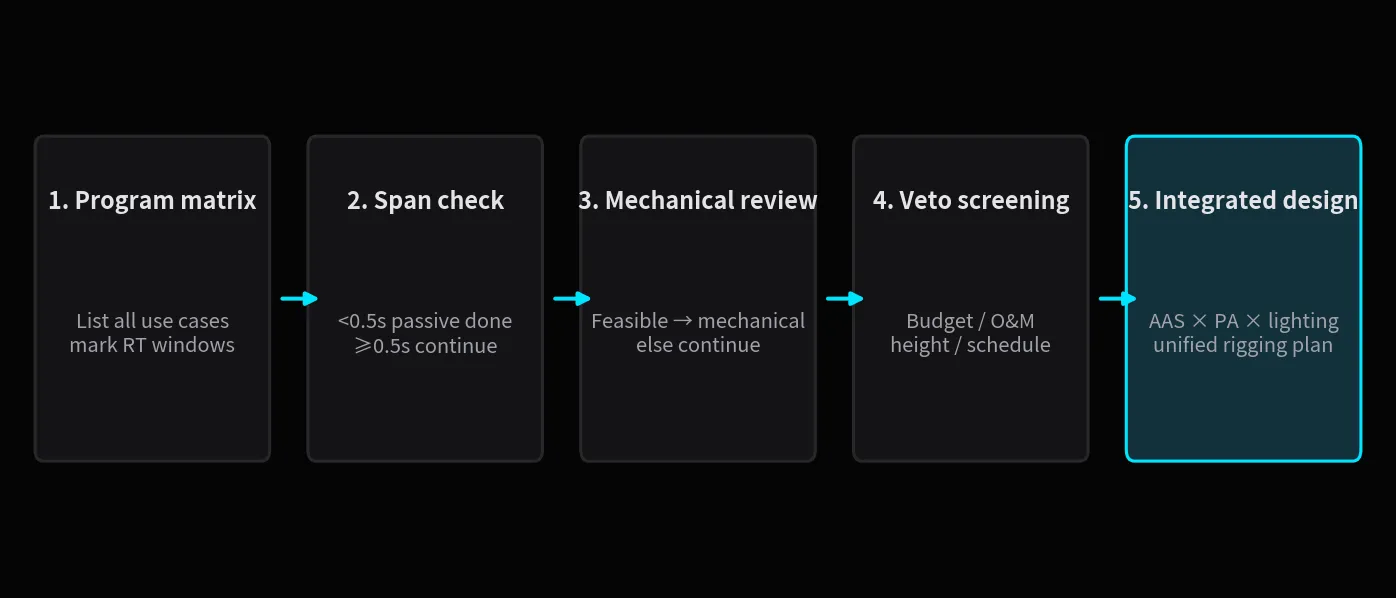
Figure 4
The five-step decision process: every step has a defined exit, turning gut feel into arithmetic.
The essence of this process is turning the question of whether to adopt from a feeling into arithmetic.
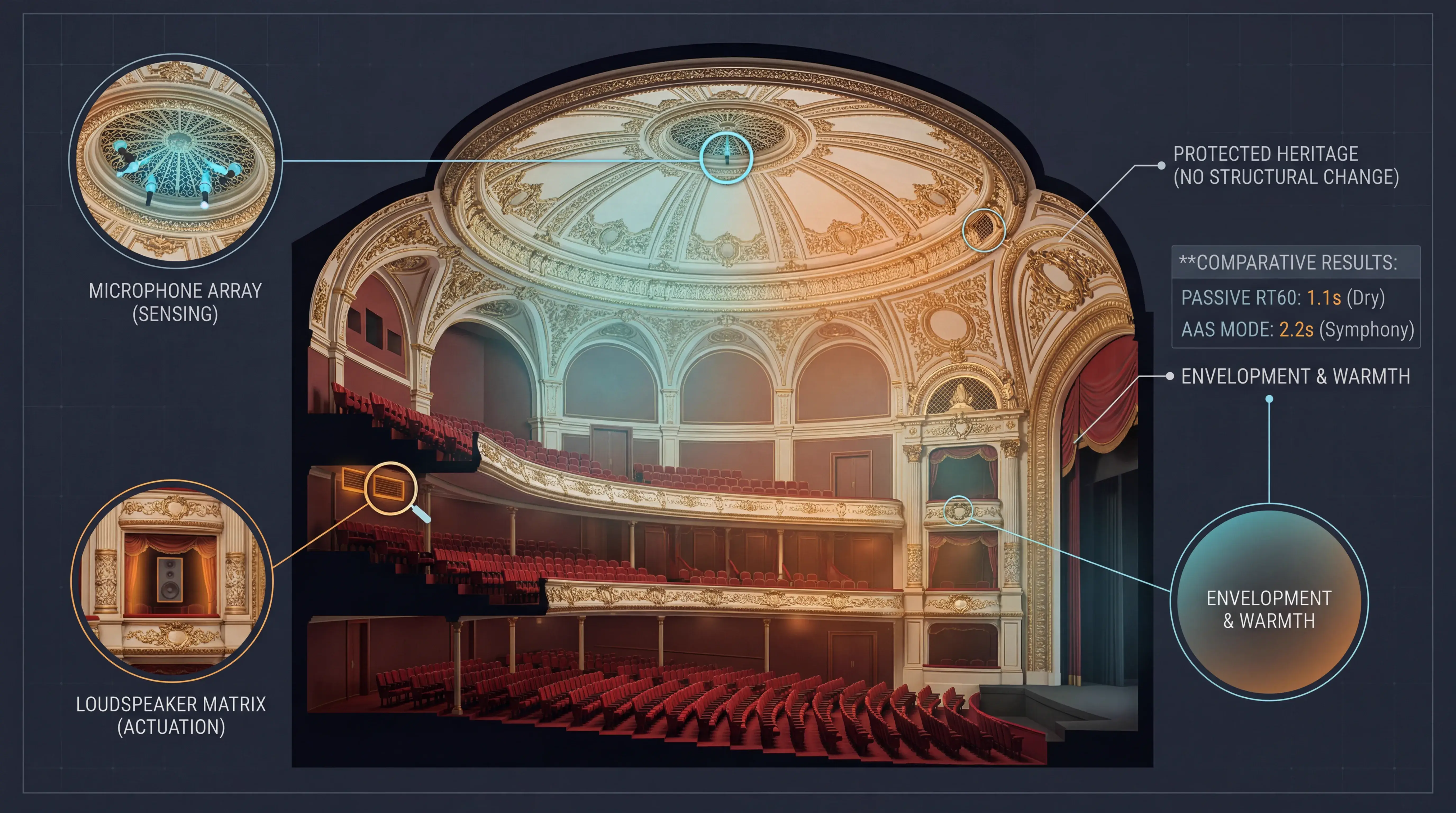
Figure 5
Active acoustics integration in an existing venue: planned together with room acoustics, lighting positions and rigging.
Active acoustics is a powerful tool for expanding what a venue can be, but it is an enhancer, not a necessity. Do the passive-acoustic math first, weigh the value of switching frequency, and hold the veto lines — at that granularity, both adoption and rejection are correct answers.