
01. Introduction: Why Meeting Rooms Keep Disappointing
Almost everyone has sat through this kind of meeting: speakers leaning into the microphone to be heard, the far end missing half the words, and an occasional shriek of feedback breaking the flow. The equipment list looks expensive; the experience is a mess.
The problem is rarely the products. Field statistics show that over 80% of conference audio complaints point to three non-product factors: microphone type mismatched to the scenario, insufficient pickup coverage, and gain structure never calculated. In other words, the meeting room is lost at design stage, not at commissioning.
This article gives the complete solution in engineering order: pick the right microphone type for the scenario first, understand the physics of feedback and keep gain margin, then let the DSP finish the job — five steps to delivery.
02. The Selection Matrix: No Universal Winner Among Four Types
Conference microphones come in four main types: gooseneck, boundary, ceiling array, and handheld/lavalier. Their differences are not about sound-quality class but about fit to the scenario. Scored across five dimensions, the conclusion is obvious:
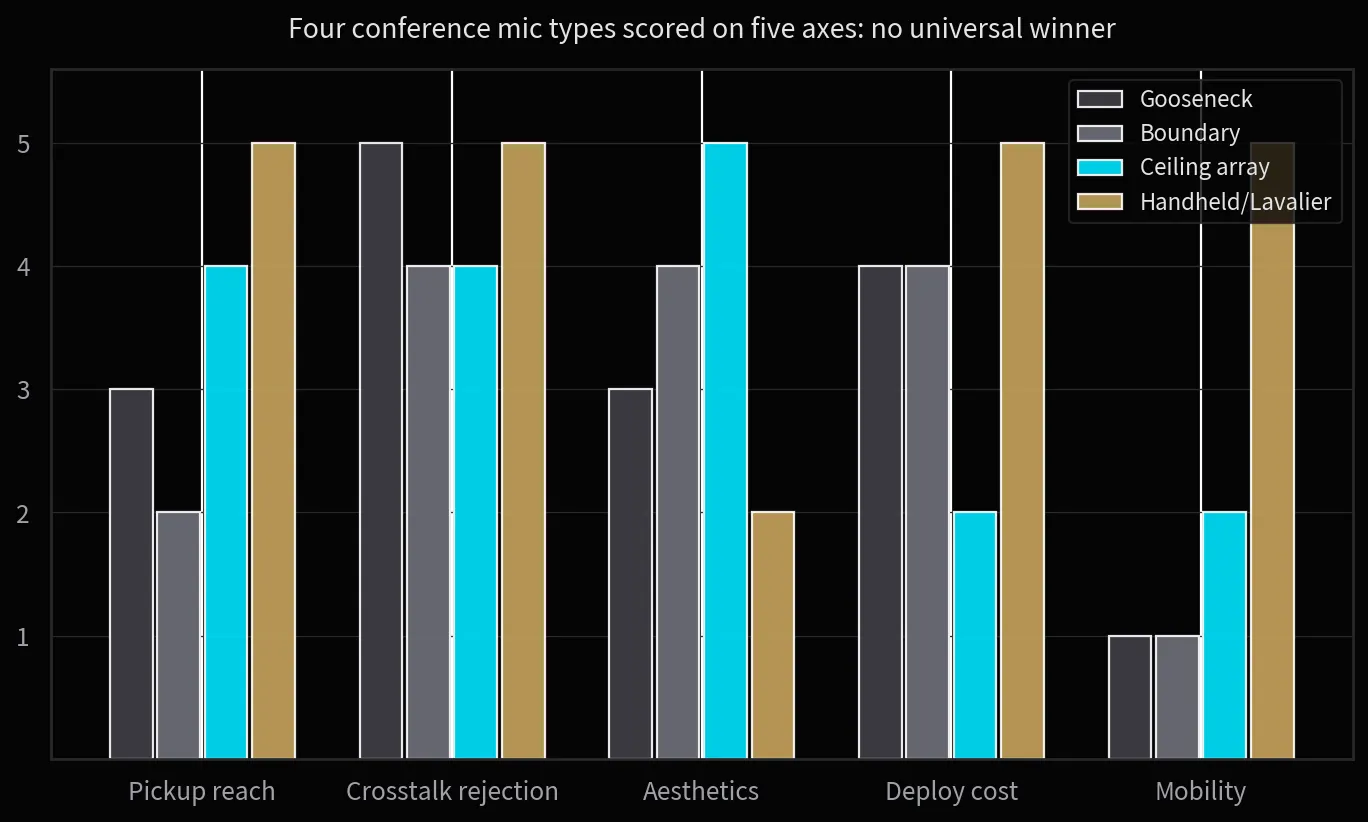
Figure 1
Five-dimension scoring of four conference microphone types: pickup distance, crosstalk resistance, aesthetics, deployment cost and mobility each have their champion.
Gooseneck: the baseline answer for fixed-seat meetings. One mic per person, clear directionality, best crosstalk rejection — ideal for boardrooms and formal government sessions; the cost is a table full of hardware.
Boundary: cleaner tabletops with two people sharing one unit, suited to small discussion tables; but pickup distance is short and sensitivity to table vibration is high — use with caution on long joined tables.
Ceiling array: zero hardware on the table, beams automatically tracking the talker — the ceiling of aesthetics and experience in high-end rooms; the costs are budget, ceiling structure and height requirements, and mandatory professional commissioning.
Handheld / lavalier: the only answer for mobile speakers and audience interaction, usually a complement rather than the main system.
There is only one selection principle: fix the scenario first, then choose the type. A ceiling array in a fixed-seat boardroom is waste; a training room full of goosenecks for a mobile audience is a disaster.
03. The Essence of Feedback: A Gain-Structure Problem
The physical chain of feedback is simple: sound picked up by the microphone is amplified through the loudspeakers and re-enters the microphone; when loop gain crosses the critical point, the system self-oscillates at one frequency. Controlling it means managing every link of that chain.
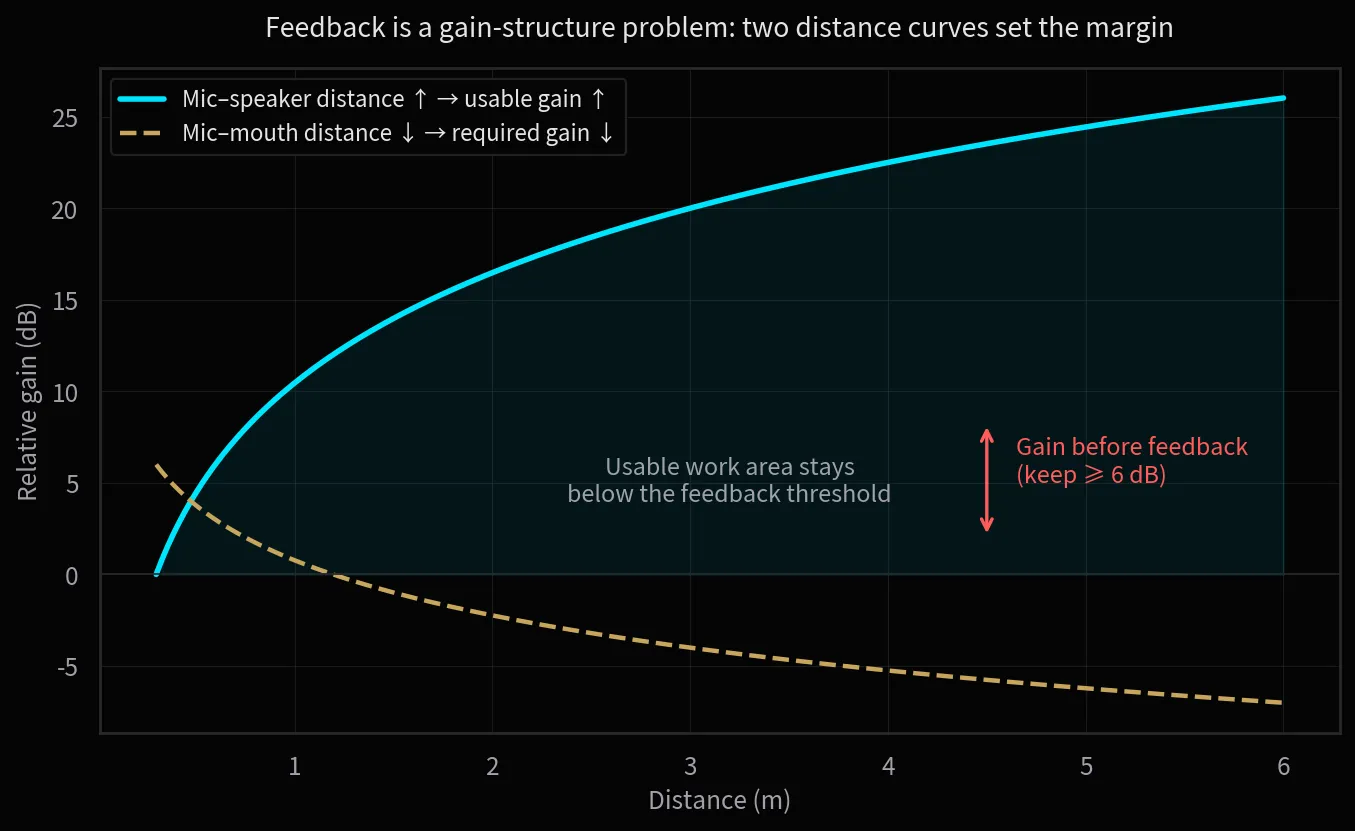
Figure 2
Two distance curves set the gain-before-feedback margin: the farther the mic from the loudspeaker and the closer to the mouth, the more stable the system.
Two distances are the levers: doubling the mic-to-loudspeaker distance adds about 6 dB of usable gain; halving the mic-to-mouth distance reduces the needed gain by about 6 dB. A layout with ceiling loudspeakers firing straight at table microphones is born handicapped, while moving the microphone closer to the talker is the cheapest stability money cannot buy.
Engineering practice requires a PAG-NAG margin of at least 6 dB. When it falls short, apply remedies in order: optimize loudspeaker-to-mic geometry → use tighter polar patterns → DSP notch filters on problem frequencies → feedback suppressor as the last resort. A suppressor is the last tool, not the first — a system held down by it sounds dull and flat by definition.
04. DSP Finishing: Automixing and Echo Cancellation
With many open microphones, channels crosstalk, noise floors add up and comb filtering hollows the sound. The automixer's job is to open only the channel in use and attenuate the rest — with the number of open mics (NOM) under control, system gain margin recovers naturally.
Video conferencing adds one more gate: acoustic echo cancellation (AEC). Far-end audio leaving the local loudspeakers, if picked up again by local microphones, returns to the far end as echo. AEC needs a reference signal unpolluted by downstream processing — a wrongly tapped reference point is the number-one cause of echo complaints in video conferences. Wire strictly by the signal-flow diagram inside the DSP, never by feel.
Commissioning order cannot be shuffled: gain structure first (mic preamps and loudspeaker levels), automixer parameters second, AEC last with two-way live tests. Reverse the order and every earlier debt detonates at the end.
05. The Delivery Process: Five Steps Before It Counts
Turn the previous four chapters into an acceptance-ready process, each step with a defined artifact:
① Scenario confirmation: number of talkers, mobile speaking or not, remote conferencing or not — output: requirements sheet.
② Microphone selection: types, quantities and spares per the five-dimension matrix — output: equipment schedule.
③ Positions and cabling: pickup-radius coverage drawings, coordinated with interior, furniture and ceiling — output: layout drawing.
④ DSP commissioning: gain structure → automix → AEC in order — output: commissioning record.
⑤ Acceptance and training: measured PAG-NAG, maximum-volume walk test, operator training — output: acceptance sheet.
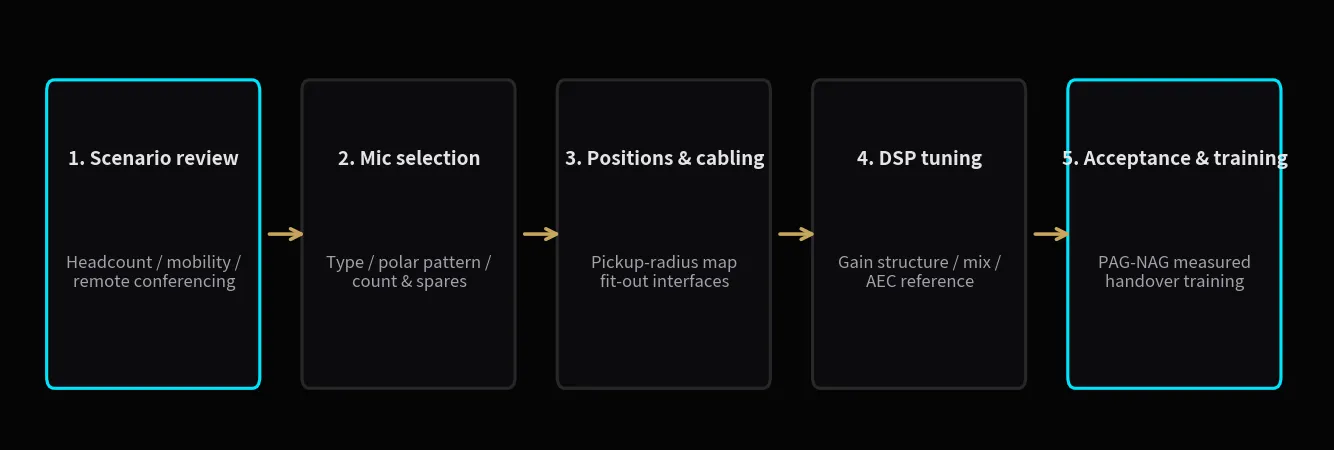
Figure 3
The five-step delivery process: every step has a defined artifact, and meeting-room delivery stops depending on luck.
The essence of this process is turning "is the room usable" from mystery into checklist.
A usable conference system is designed, not tuned. Microphones matched to scenarios, gain calculated from distances, DSP commissioned in order, acceptance measured against standards — at that granularity, the room works the day it opens.